Wolf Howling at the Moon Embroidery
First Impressions: A Design That Breathes Wild Quiet
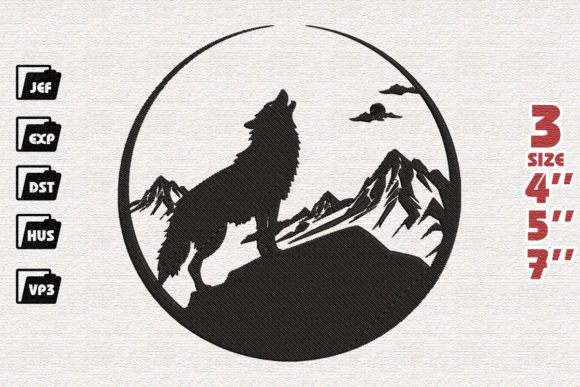
When I opened the Wolf Howling at the Moon Embroidery file, what struck me wasn’t just the silhouette—it was the stillness in the posture. The wolf’s head is tilted just enough, ears perked, tail low and grounded. There’s no aggression, no cartoon exaggeration—just focused reverence. That matters. In a sea of overdesigned animal motifs, this one lands with quiet confidence. It reads as mature, thoughtful, and deeply wearable—not just for wilderness lovers, but for anyone drawn to symbolism that feels earned, not slapped on.
Real Project Test: A Linen Tote Bag for a Local Bookstore Pop-Up
Last month, I used the Wolf Howling at the Moon Embroidery on a natural linen tote for a small indie bookstore’s autumn launch. We chose a 4.5" hoop size and medium-weight cutaway stabilizer. Why? Because linen breathes—and shifts. The design held its shape beautifully: clean satin-stitched outer edges, balanced fill stitch density in the moon and wolf’s shoulder, and subtle running stitch accents in the fur texture that didn’t overwhelm the fabric. Customers paused. They didn’t just see “a wolf”—they saw intention. One woman asked if it was hand-drawn first (it wasn’t—but the flow of the machine embroidery made it feel like it could’ve been).
Where This Design Truly Shines
- Custom apparel: Works exceptionally well on sweatshirt cuffs, back yokes, or chest pockets—especially on midweight cotton or French terry where stitch definition stays crisp.
- Tote bag design: Its vertical orientation and strong negative space make it legible even at 3.75", without losing presence.
- Pillow covers & nursery decor: Softens beautifully on linen-cotton blends. No harsh angles or tiny interior details that snag during washing.
- Embroidered patch: Clean outer perimeter and moderate stitch count mean it backs well onto twill or denim without excessive bulk.
- Holiday embroidery & personalized gifts: Paired with a simple monogram or date in a neutral thread, it becomes quietly meaningful—a baby’s first winter, a graduation gift, a vow renewal keepsake.
Use With Care: Practical Boundaries
This isn’t a one-size-fits-all motif—and that’s a strength, not a limitation. Here’s where attention pays off:
- Small hoop sizes under 3": The moon’s curve and inner wolf eye detail begin to compress. If you need sub-3" scale, test stitch density first—you may want to simplify or omit fine interior lines.
- Stretchy fabric (like jersey or rib knit): Requires excellent stabilization—preferably tear-away + light cutaway combo—and slower stitching speed. The design’s long, continuous satin stitches can pucker if tension isn’t dialed in.
- Dark fabric + light thread: The moon’s fill area benefits from a slight underlay. Without it, the white or cream thread can look thin against black or navy.
- Curved surfaces (caps, beanies): Avoid placing the full design across the crown seam. Center it on the front panel instead—its vertical rhythm reads better there than sideways.
- Frequent-wash items (baby onesies, tea towels): Confirm your thread is polyester or high-quality rayon, and use stabilizer rated for repeated laundering. The design’s open structure helps—it doesn’t trap moisture like ultra-dense fills do.
What It Adds to Your Finished Product—Beyond Aesthetics
The Wolf Howling at the Moon Embroidery elevates perception. On an Etsy listing, it signals craftsmanship—not just “embroidered,” but *considered*. Buyers associate that quiet strength with quality handmade product standards. For craft business owners, it builds brand consistency when used across a seasonal collection (e.g., paired with subtle pine branch motifs or muted charcoal thread palettes). As a digital embroidery file, it performs well in printable mockups—the contrast between wolf, moon, and background remains clear even in grayscale previews. And yes, customers notice. At craft fairs, people touch the tote before they ask the price. That tactile pause? That’s trust building.
Designer Notes You’ll Actually Use
- Always run a test stitch on scrap fabric matching your project’s weight and weave—even if you’ve used this design before.
- Check thread color contrast in natural light. What looks bold on screen may mute on oat linen or heather gray.
- Review stitch density visually: zoom into the moon’s edge and wolf’s muzzle in your embroidery software. Look for gaps or over-stitching that could cause stiffness.
- Confirm hoop size compatibility with your machine and intended placement—especially for sleeves or curved seams.
- Inspect small details at actual stitch-out size. That subtle curve in the wolf’s ear? It should read as intentional—not accidental.
- Test it in black-and-white mockups. If it loses clarity or balance without color, reconsider thread choices or placement.
- Compare performance on light vs. dark fabric backgrounds. Some designs gain drama on black; this one gains depth on oat or stone.
- Use appropriate stabilizer—not just “any” cutaway. Medium-weight works best for most applications here.
- Verify licensing terms before selling finished items or bundling the Wolf Howling at the Moon Embroidery as part of a digital product pack.
A Final Thought for Creative Entrepreneurs
As a designer who’s reviewed hundreds of wild animal embroidery files, I can say this: the Wolf Howling at the Moon Embroidery stands out not because it’s flashy, but because it’s resolved. Every line serves the mood. Every stitch supports readability. It doesn’t shout—it resonates. Whether you’re embroidering a single holiday gift or scaling up for a boutique’s limited-run capsule, this design earns its place. It’s not just a machine embroidery design. It’s a quiet collaborator in your creative work.