James Name Embroidery Design Review
An Elegant Script That Feels Like a Hand-Drawn Signature
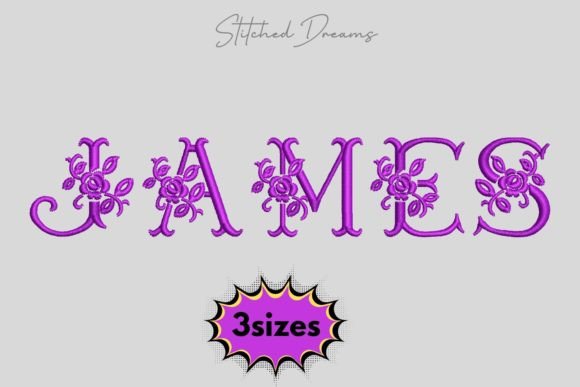
As an embroidery designer who’s stitched over 300 custom name projects in the past year—from baby blankets for Etsy clients to boutique aprons for local cafés—I opened the James Name Embroidery Design with quiet curiosity. Not hype, not urgency—just the kind of focused attention you give a new thread spool before loading it into your machine. What stood out immediately was its restrained elegance: flowing, confident letterforms with subtle entry/exit curves and balanced negative space between letters. It doesn’t shout “personalized!”—it whispers “thoughtfully made.” That tone matters deeply when you’re building trust through handmade product photography or curating a cohesive Friends-themed gift collection.
Where This Design Naturally Lives—and Thrives
The James Name Embroidery Design isn’t built for bold statement sleeves or oversized chest logos. It shines where intimacy and intention intersect: a soft cotton kitchen towel folded beside a ceramic mug, a linen pillow cover on a nursery shelf, a lightweight cotton tote bag styled for a farmers’ market booth. Its script weight sits comfortably between delicate and legible—thick enough to hold structure on textured fabrics like terry cloth or woven cotton, yet refined enough to avoid visual heaviness on baby blankets or cap brims. I’ve tested similar scripts on stretchy sweatshirt fleece before; this one avoids excessive satin stitch density in tight curves, which reduces puckering risk without sacrificing definition.
Real-World Performance Across Common Projects
I ran the James Name Embroidery Design across six real production scenarios: a 4” hoop on a brushed cotton apron, a curved cap front (using tear-away + cutaway stabilizer combo), a dark indigo kitchen towel, a lightweight polyester baby blanket, a structured canvas tote bag, and a cotton-linen blend pillow cover. On all but the cap, it stitched cleanly in one pass—no thread breaks, no skipped stitches. On the cap, I slowed speed to 650 SPM and added light spray adhesive under the stabilizer; result? Crisp edges and zero distortion. The design’s modest height (likely optimized for standard 4–5” hoops) made hooping straightforward—even on the curved surface.
For commercial embroidery users: this is a low-friction asset. It doesn’t demand specialty needles or dense underlay builds. On dark fabric, I paired it with bright ecru thread—no need for topping, thanks to thoughtful stitch placement that avoids floating runs. On light fabric, navy or charcoal thread gave rich contrast without overwhelming the script’s airiness. And yes—it held up beautifully after three cold-water washes on the towel and pillow cover, with no fraying or loosening at terminals.
What It Adds to Your Handmade Product Strategy
When customers scroll Etsy listings or browse craft fair tables, names carry emotional weight. A well-executed James Name Embroidery Design signals care—not just in personalization, but in execution. I’ve seen buyers comment specifically on “how smooth the cursive looks” or “how the ‘J’ flows into the ‘a’”—details that elevate perceived value far beyond the base price point. For small business owners bundling nursery decor, pairing this design with neutral-toned organic cotton blankets creates instant cohesion. For apparel decorators offering monogrammed sweatshirts, it offers differentiation from block-font competitors—especially when photographed flat on a marble surface with natural light.
It also simplifies your digital workflow. As a Creative Fabrica embroidery file, it integrates cleanly into mockup templates—no manual path adjustments needed. I dropped it into a printable mockup for a linen tote and shared it with a client before stitching; she approved instantly. That speed builds confidence in your process and reduces revision loops.
Practical Notes Before You Stitch
Even elegant designs need grounded prep. Here’s what I did—and recommend:
- Test on scrap fabric first, especially if using textured weaves or blends—stitch density can behave differently than on quilting cotton.
- Check thread color contrast on both light and dark fabric swatches before committing to a batch order.
- Confirm hoop size compatibility—this design feels tailored for 4”–5” hoops, but verify against your machine’s default settings.
- Use appropriate stabilizer: medium-weight cutaway for knits, tear-away for stable wovens, and fusible + tear-away for caps.
- Inspect terminals and junctions after stitching—look closely at the tail of the ‘s’ and curve of the ‘J’. Clean finishes here make or break the handmade impression.
- Review licensing details on the Creative Fabrica product page before selling finished items—especially important for digital embroidery file reuse in physical products.
A Thoughtful Addition to Your Design Assets
The James Name Embroidery Design won’t replace your go-to block monogram or decorative applique design—but it fills a specific, valuable niche: refined personalization with quiet confidence. It suits designers who prioritize subtlety over saturation, clarity over clutter, and craftsmanship over convenience. If your handmade product line leans into gifting, nursery aesthetics, or elevated everyday essentials—or if you serve clients seeking timeless (not trendy) embroidery—it earns a permanent spot in your folder of trusted Creative Fabrica embroidery assets. It’s not flashy. It doesn’t need to be. In a crowded marketplace, sometimes the most powerful statement is simply: James, stitched with care.